
Vulcanised India Rubber (VIR) Cable: Why Ageing Wiring Still Needs Attention
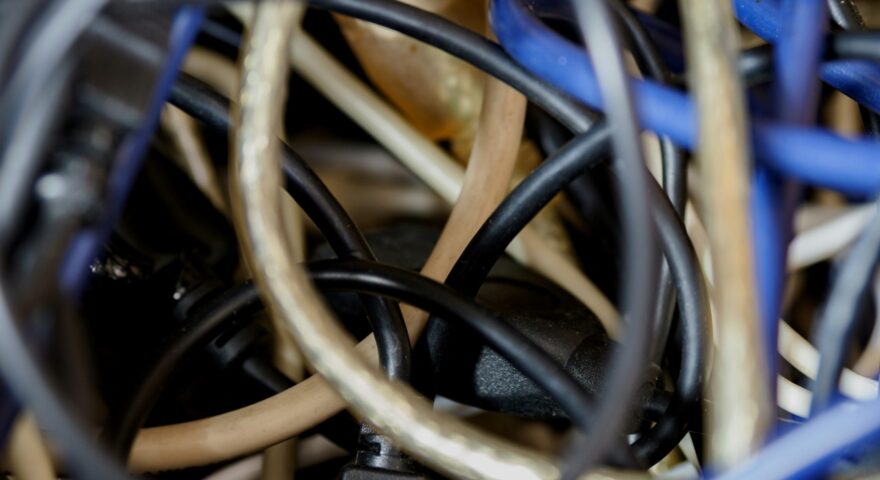
VIR cable remains one of the more persistent legacy problems in older UK building stock. It appears in properties never fully rewired, in installations updated only in part, and in the risers and landlord areas of buildings where original distribution circuits have never been replaced. Long after it stopped being best practice to install them, VIR cables can still be found in buildings across the UK
The material is the issue. Rubber insulation has a finite service life, and cable fit for purpose when installed decades ago is very unlikely to be fit for purpose now.
At BSEFM, we deliver design and replacement solutions for buildings where legacy wiring has reached the end of its service life.
Understanding VIR Cable
Vulcanised India Rubber cable uses a vulcanised natural rubber compound as the insulating layer around the copper conductor, usually with a cotton or textile braid over the top and, in many installations, a lead or tough rubber sheath. It was standard practice across UK installations for much of the first half of the twentieth century and was progressively replaced by PVC insulated cable from the 1960s onwards.
At the time it was a sound choice. Rubber insulated well, handled flexing, and suited the wiring methods of the period, which typically meant conduit runs and surface mounted distribution. The problem is not how it was made but how it ages.
The Risks of Ageing VIR Cable
Rubber compounds oxidise and lose plasticiser content over time. Heat accelerates the process, as does the ordinary operating temperature of a loaded circuit. The practical results include:
- Insulation hardening, shrinking back and cracking at terminations
- Bare copper exposed at consumer units and switch boxes
- Perished textile braiding offering no residual protection
- Insulation resistance falling below BS 7671 requirements
- Risk of arcing faults developing in concealed voids and conduit runs
Disturbance and Refurbishment Risk
Cable that has held up in situ can fail the moment it is moved. Work in ceiling voids, loft spaces or risers is a common trigger for faults appearing on circuits that had been functioning without issue. Refurbishment, plant replacement and the installation of new services all carry this risk, and the fault does not always announce itself immediately. Where legacy wiring is present, its condition should be established before works begin rather than discovered during them during works.
Identifying VIR Cable
Positive identification requires inspection and testing by a competent person, but the indicators are consistent:
- Hard, inflexible insulation, typically dark brown or black
- Woven cotton or textile braid, sometimes with a lead sheath
- Vulcanised rubber that crumbles or flakes when handled
- Cable in steel conduit, wooden capping or surface clipped
- Round pin sockets and rewireable fuse carriers elsewhere in the installation
Age of the building is an indication rather than proof. Partial rewires are common, which means modern PVC cable at the accessories can sit on original VIR further back in the circuit.
Assessment and Replacement
Where VIR is suspected or confirmed, the appropriate response is an Electrical Installation Condition Report carried out under BS 7671 https://www.bsefm.com/our-services/electrical-inspection-condition-report, establishing the condition of the installation, the insulation resistance values achieved and the extent of the legacy wiring. In most cases the outcome is full replacement rather than partial remedial work, because localised repairs to a cable type failing along its whole length do not resolve the underlying condition.
In multiple-occupancy and commercial buildings the assessment also needs to establish where responsibility sits. Legacy distribution in risers, intake positions and communal areas typically falls within the Building Network Operator’s remit, and upgrade work often needs coordination with the DNO where the intake position is being altered.
Designing the Replacement
Removing legacy wiring from an occupied building requires design work that accounts for both compliance and continuity of supply. Our electrical design services cover:
- Review of inspection and test results against the existing installation
- Scope definition for full or phased replacement
- Staged schemes maintaining supply to tenants and communal services
- New earthing and bonding arrangements which legacy installations frequently lack
- Consideration for capacity for load growth, including EV charging and heat pumps
- Collaboration with other contractors (as required) through the installation
Bringing Legacy Installations Up to Standard
Ageing wiring rarely fails on a convenient schedule, and in shared buildings a single degraded circuit affects more than one occupant. At BSEFM we combine electrical design expertise with practical delivery experience to replace legacy installations safely and with minimal disruption to the building in use. Cable of this age has reached the end of its serviceable life and replacement should be planned rather than forced by failure.
Want to speak to our expert engineering team? Please email mail@bsefm.com or call 0207 953 4047.
Talk to Our Expert Team
If you would like to learn more about the range of services we offer, please get in touch for an informal discussion about your needs and requirements.